Construction and demolition roll-off containers handle high-volume debris that exceeds Dauphin County curbside limits, from plaster gutting in historic Midtown rowhouses to structural framing near Italian Lake.…
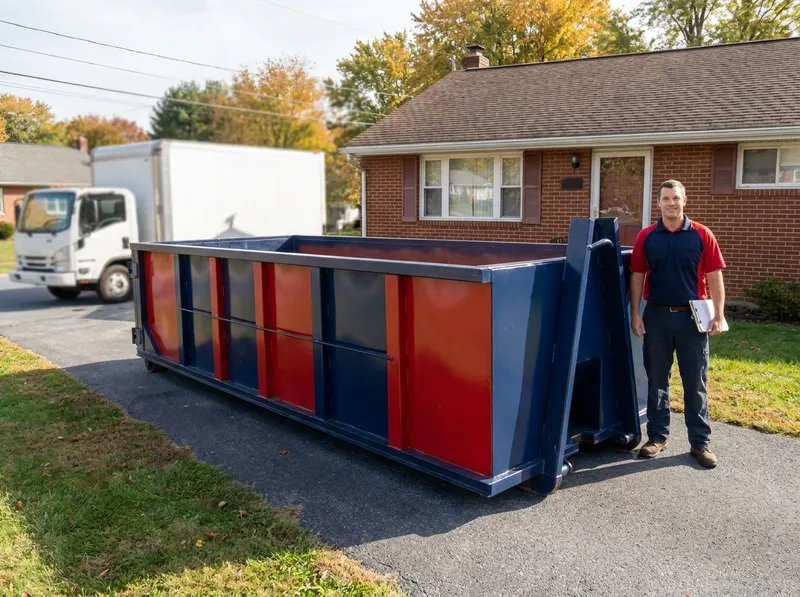
Construction and demolition roll-off containers handle high-volume debris that exceeds Dauphin County curbside limits, from plaster gutting in historic Midtown rowhouses to structural framing near Italian Lake. Selecting the right container volume comes down to balancing debris density against physical driveway access. A 10-yard container ($595) holds roughly 4 standard pickup truck beds of dense material like tile or plaster, fitting tight, narrow footprints common to Allison Hill or Shipoke properties. For full residential roof tear-offs or multi-room gutting in Bellevue Park, a 30-yard container ($795) accommodates approximately 12 pickup loads, though it requires at least 60 feet of linear clearance for safe hydraulic truck maneuvering. The operational trade-off is footprint versus hauling capacity: smaller containers fit restricted alley approaches but require careful packing of long dimensional lumber, while larger boxes handle framing studs tossed flat but require wide access clearances away from low-hanging utility wires.
Placement mechanics matter on historic and sloped surfaces. In neighborhoods like Riverside or the Capitol District, containers placed directly on asphalt or concrete driveways risk surface gouges from heavy steel rollers. Every delivery utilizes protective wooden blocking beneath the container contact points to distribute weight evenly and prevent surface cracking. For placement in public rights-of-way or on city streets where private driveways do not exist, Harrisburg City Hall requires a street occupancy permit prior to drop-off. Containers dropped on private property, such as private gravel parking pads or asphalt driveways, bypass municipal permitting entirely, keeping setup fast and frictionless.
Material classification strictly separates structural waste from hazardous items to avoid transfer station rejections. Solid dimensional lumber, framing scraps, drywall, plywood, pipes, insulation, and architectural trim move through disposal facilities without issue. Hazardous fluids, wet paint cans, chemical solvents, tires, and freon-bearing appliances cannot enter standard demolition containers under state environmental rules. Booking involves three utilitarian steps: 1. Call (717) 678-6075 to identify your square footage and materials. 2. Confirm a level drop zone free of overhead trees or wires. 3. Fill the container level with the top rim for safe tarping and transport.
Every job gets a firm, written price after a free on-site visit.
Tell us about your construction & demolition dumpster job in Harrisburg and we'll send a clear, written quote, usually the same day.
 DumpHub Dumpster Rental